Imagine this.
A potential customer hears about your business from a friend, sees one of your social media posts, or discovers your name somewhere online. They are interested, so the next thing they do is search for your business on Google.
But instead of finding a professional website explaining who you are, what you offer, and why they should choose you, they find very little information. Meanwhile, one of your competitors appears with a modern website, clear services, customer reviews, contact details, useful content, and an easy way to request a quotation.
Who is more likely to get the customer?
This is one of the simplest reasons why every business needs a website in 2026 for growth.
A professional website is no longer just an online business card. It can become the central platform behind your entire online presence, helping you build credibility, appear in Google searches, generate leads, sell products, accept bookings, automate business processes, collect valuable data, and turn visitors into customers.
Whether you operate a small local business, startup, eCommerce store, hotel, consultancy, clinic, professional service company, or growing organization, your website can become one of your most valuable long-term digital assets.
Let’s look at why.
Why Does Every Business Need a Website?
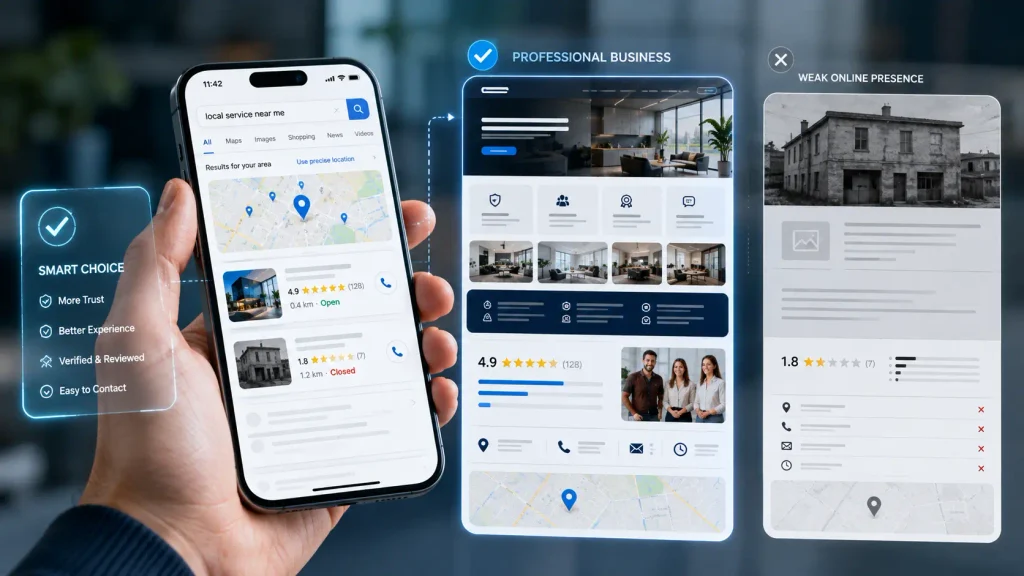
The way customers discover and evaluate businesses has changed significantly.
Before contacting a company, many customers research it online. They may search its name on Google, compare services, read reviews, browse products, look at previous projects, check prices, or simply confirm that the company appears legitimate.
If your business does not have a professional online presence, you may lose customers before you even know they were interested.
The Importance of a Website for Modern Businesses
Today’s customers expect information immediately.
When someone wants a service, they rarely want to make several phone calls just to understand what a company offers. They want to search online, compare options, and make an informed decision.
A website allows potential customers to discover information about your business whenever they need it.
They can understand your services, view products, see previous work, check testimonials, request a quotation, send an enquiry, book an appointment, or purchase something directly.
Your website therefore helps customers move from:
Discovery → Research → Trust → Action
without requiring your team to manually guide every visitor through the process.
How a Professional Website Contributes to Business Growth
Facebook, Instagram, LinkedIn, TikTok, and other platforms are valuable marketing channels, but your business does not control them.
Algorithms change.
Organic reach changes.
Advertising policies change.
Accounts can be restricted.
Platforms can become less popular.
Your website is different.
You control the design, content, pages, customer journey, calls to action, analytics, functionality, and overall experience.
Think of social media as the places where conversations happen.
Your website is the place where your business lives online.
Why a Website Still Matters in the Age of AI
The role of websites has expanded significantly.
A modern business website can support traditional Google Search, local SEO, AI-powered search experiences, advertising campaigns, social media marketing, email marketing, lead generation, eCommerce, bookings and business automation.
Google has confirmed that existing SEO fundamentals remain relevant to its generative AI experiences such as AI Overviews and AI Mode. Websites still need useful content, crawlable pages, good technical foundations and a strong user experience to compete for search visibility.
That means a well-built website remains an important foundation for digital growth in 2026.
12 Benefits of Having a Website for Your Business
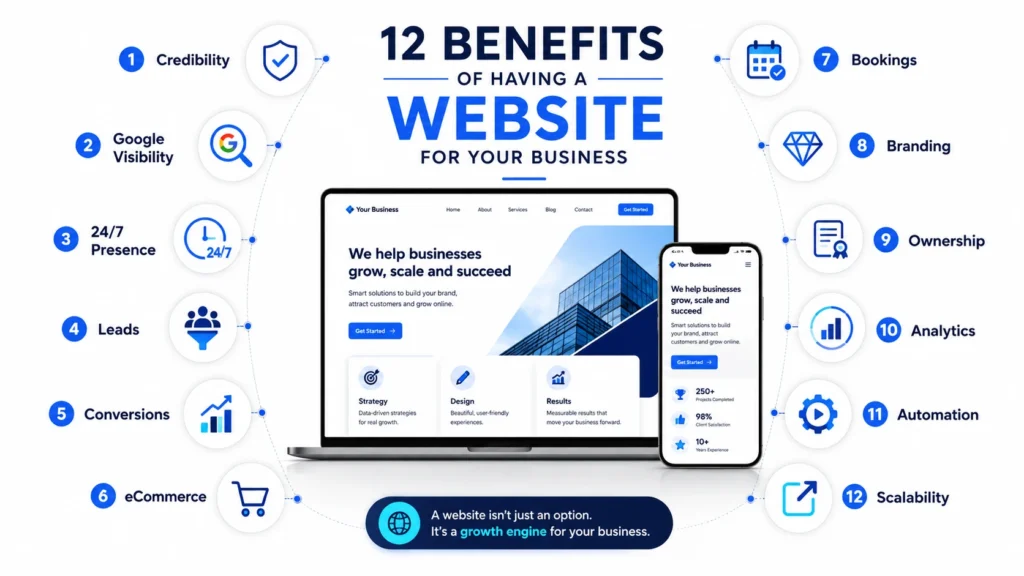
A website can support almost every stage of the customer journey.
Here are twelve of the most important benefits.
1. A Professional Website Builds Customer Trust
First impressions matter.
If a customer discovers two businesses offering similar services and only one has a polished, professional website, the company with the stronger online presence often appears more established and trustworthy.
A professional business website can clearly display your company information, services, contact details, portfolio, testimonials, certifications, team, location, and other trust signals.
It tells visitors:
“This is a real business, and we take our work seriously.”
The quality of the website also influences that perception. An outdated, broken, or poorly designed website may create almost the same problem as having no website at all.
Your website therefore needs to represent the quality of the business behind it.
2. A Website Helps Businesses Get Found Online
One of the biggest advantages of having a website is the opportunity to attract customers who are already searching for what you offer.
Imagine you operate a hotel in Ella.
Someone searches:
hotel in Ella
Or you run a web development business and someone searches:
web developer Sri Lanka
A properly optimized website allows your business to appear for searches like these.
Through SEO, you can create dedicated pages around your services, products, locations, and customer questions.
Over time, those pages can attract relevant organic traffic from people actively searching for solutions.
Your website therefore becomes more than a digital brochure.
It can become a customer acquisition channel.
3. Your Website Keeps Your Business Available 24/7
Your office may close at 5 PM.
Your website does not.
Customers can discover your business, view services, browse products, send enquiries, request quotations or book appointments at any time.
For an eCommerce business, customers can even complete purchases while your team is offline.
This gives your business a digital presence that works continuously.
A good website does not replace your sales or customer service team. It helps them by answering basic questions and giving interested customers a clear next step.
4. A Website Can Generate Qualified Leads
Traffic alone does not grow a business.
The important question is what visitors do after reaching your website.
A conversion-focused website can turn visitors into enquiries through contact forms, quotation requests, phone calls, WhatsApp buttons, consultation bookings, newsletter subscriptions and other lead-generation methods.
The website can also qualify leads.
For example, instead of receiving a message saying:
“Hi, I need a website.”
you could use a project enquiry form that asks about the business type, required functionality, approximate scope and goals.
This gives your team better information before the conversation even begins.
5. A Well-Designed Website Improves Conversion
Getting traffic is only part of the process.
Your website needs to guide visitors toward action.
This is where user experience and conversion-focused design become important.
A good business website gives visitors a clear path:
Understand the problem → Discover your solution → See evidence → Build trust → Take action
Strong headlines, clear service descriptions, testimonials, portfolio examples, effective calls to action, and simple navigation all contribute to conversions.
The objective should not be to make the website look impressive for design’s sake.
The objective should be to help users accomplish what they came to do.
6. Sell Products and Services Online
For product-based businesses, a website can open an entirely new sales channel.
An eCommerce website allows customers to browse products, view information, add products to a cart, complete payments, and manage their orders online.
Platforms such as WooCommerce can support everything from small online shops to more complex stores with categories, payment gateways, shipping options, customer accounts, and advanced product management.
A well-planned eCommerce solution can help your business sell beyond the limitations of a physical location.
Your shop may be in one city.
Your website can reach customers across the country or internationally.
7. Accept Appointments and Reservations Online
Websites can also automate bookings.
Hotels can allow guests to check availability.
Clinics can accept appointments.
Consultants can schedule meetings.
Salons can allow customers to select treatments.
Tourism businesses can collect reservation requests.
Restaurants can manage reservations.
Instead of depending completely on calls and messages, a professionally developed booking system can organize availability, customer details, notifications, and even payments.
This saves administrative time while making the booking process more convenient for customers.
8. Build a Strong and Professional Brand
Social media profiles restrict how much control you have over presentation.
Your website gives you much greater freedom.
You control your typography, colors, photography, layout, content, messaging, positioning, and customer journey.
Every page can reinforce what your business represents.
A premium brand can create a premium digital experience.
A modern technology company can communicate innovation.
A family business can emphasize trust and history.
A tourism brand can create an immersive visual experience around destinations.
Good website design is therefore not just decoration.
It is part of brand communication.
9. Own and Control Your Online Presence
Building a business entirely on third-party platforms creates dependency.
Imagine spending years growing a social media audience and suddenly experiencing an account restriction, major algorithm change, or significant drop in organic reach.
Your website reduces that dependency.
Your social media platforms can send users to your website, but your main business information, valuable content, service pages, and conversion mechanisms remain on an asset you control.
A strong digital strategy therefore uses social media and a website together rather than treating them as competitors.
10. Use Website Data to Make Better Business Decisions
A website can help you understand how customers interact with your business.
With tools such as Google Analytics and Google Search Console, you can learn which pages receive traffic, how people discover your website, what search queries generate impressions, which services attract attention, and where conversions happen.
This allows business decisions to become more data-driven.
Instead of guessing which service customers care about most, you can observe user behaviour.
Instead of guessing whether SEO is creating visibility, you can measure it.
Instead of simply saying, “Our website gets visitors,” you can ask:
Which visitors become customers?
That is a much more useful business question.
11. Connect Your Website With Digital Marketing and Automation
Modern websites can connect with the rest of your business technology.
Through API and custom integrations, a website can communicate with CRM platforms, payment processors, email systems, booking software, inventory systems, accounting tools, and other third-party services.
Imagine a customer completing an enquiry form.
Instead of someone manually copying the information into different systems, the website could automatically send the information to your CRM, notify your sales team, and trigger an email response.
The website is no longer just displaying information.
It is participating in business operations.
12. Build a Scalable Website for Long-Term Business Growth
Your website does not need to remain exactly as it was on launch day.
A properly developed website can grow with your company.
You may initially need a five-page business website.
Later, you might add a blog.
Then a booking system.
Then online payments.
Then customer accounts.
Then CRM integration.
Then custom functionality.
This is why website architecture matters.
A cheap website that becomes impossible to expand may eventually cost more than building a scalable platform correctly from the beginning.
A Website Helps Customers Find You in Google and AI Search
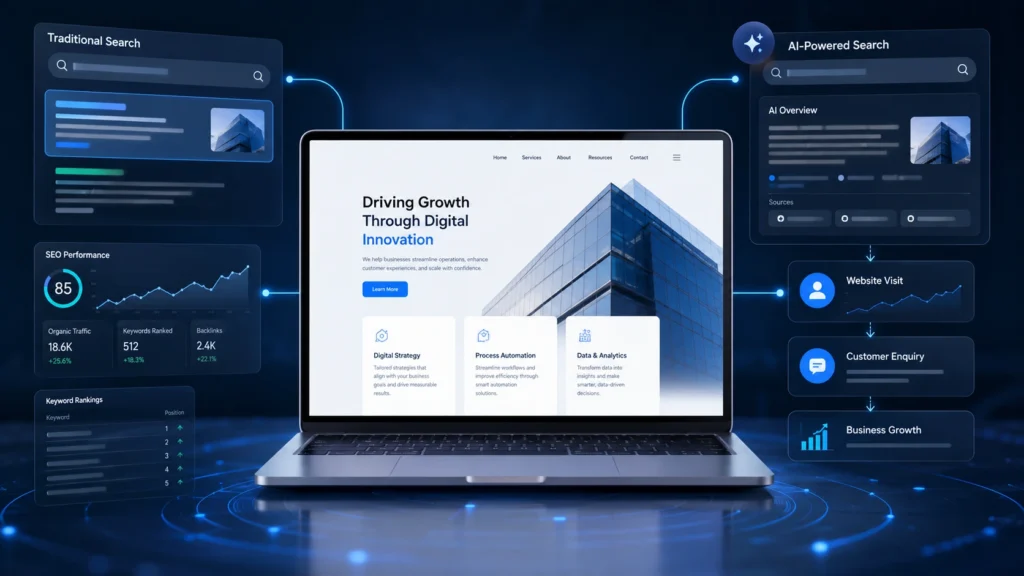
Search is evolving, but websites remain central to how businesses are discovered online.
SEO Turns Your Website Into a Customer Acquisition Channel
SEO helps search engines understand your website and connect relevant pages with relevant searches.
The basic journey is simple:
Search query → Google result → Website visit → Enquiry → Customer
Imagine you offer five different services.
Instead of creating one generic page that briefly mentions everything, you can create dedicated pages explaining each service.
Each page can address a different customer need and search intent.
This creates more opportunities to appear in relevant searches while also giving visitors more useful information.
Good SEO therefore begins with the website’s structure, content, and technical foundation.
Local Businesses Can Target Service and Location Searches
Websites are particularly valuable for businesses serving defined geographic areas.
A customer may search for something such as:
web developer Sri Lanka
hotel in Ella
dentist in Colombo
SEO specialist Sri Lanka
car rental in Kandy
Creating useful pages that clearly explain your service and geographic relevance can help search engines understand where your business fits.
This should be supported by proper technical SEO, useful content, and legitimate local business signals rather than simply repeating location keywords throughout a page.
Websites Can Support Visibility in AI-Powered Search
AI-powered discovery is another reason websites matter in 2026.
Google now includes generative AI experiences such as AI Overviews and AI Mode, and Google states that established SEO best practices continue to be relevant because these experiences are connected to its core Search systems.
The goal should not be to chase every new acronym such as “GEO” or “AEO” with artificial optimization tricks.
Focus on fundamentals.
Publish genuinely useful information.
Explain your expertise clearly.
Create crawlable pages.
Maintain strong technical SEO.
Make information easy to understand.
Use descriptive images and structured data where appropriate.
Keep important business information accurate.
The better your website communicates what your business knows and does, the stronger its foundation for both traditional and evolving search experiences.
Why Social Media Alone Isn’t Enough for a Business
Social media is extremely valuable.
But social media should complement your website, not replace it.
You Don’t Control Social Media Platforms
Your Instagram followers belong to Instagram’s ecosystem.
Your Facebook audience exists inside Facebook.
Your TikTok reach depends on TikTok’s platform.
You do not control their algorithms, policies, or product decisions.
Your website gives your business significantly more control over the customer experience.
That doesn’t mean abandoning social media.
It means using each platform for what it does best.
Social Media and Websites Serve Different Purposes
A simple way to think about it is:
Social media = discovery and engagement
Website = credibility, information, and conversion
A customer may discover your brand from an Instagram Reel.
They may then visit your website to research your services.
They may read a case study.
They may check reviews.
Finally, they may submit an enquiry.
Both channels have contributed to the sale.
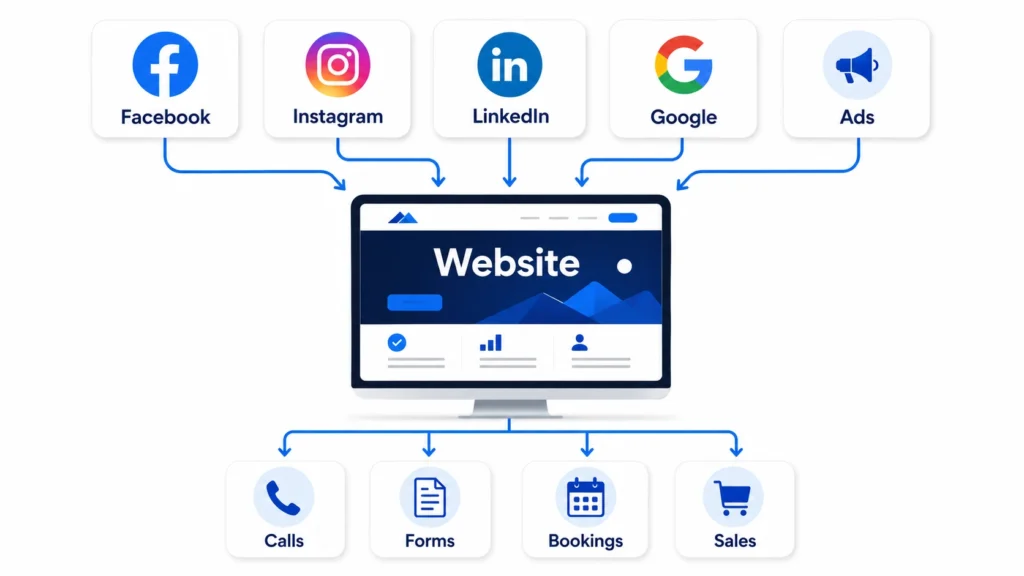
Your Website Should Be at the Center of Your Digital Marketing Ecosystem
Your website can act as the destination behind multiple marketing channels:
Google + Facebook + Instagram + LinkedIn + Email + Advertising → Website → Conversion
Instead of building disconnected marketing activities, your website brings them together around a common business objective.
What Features Should a Business Website Have in 2026?
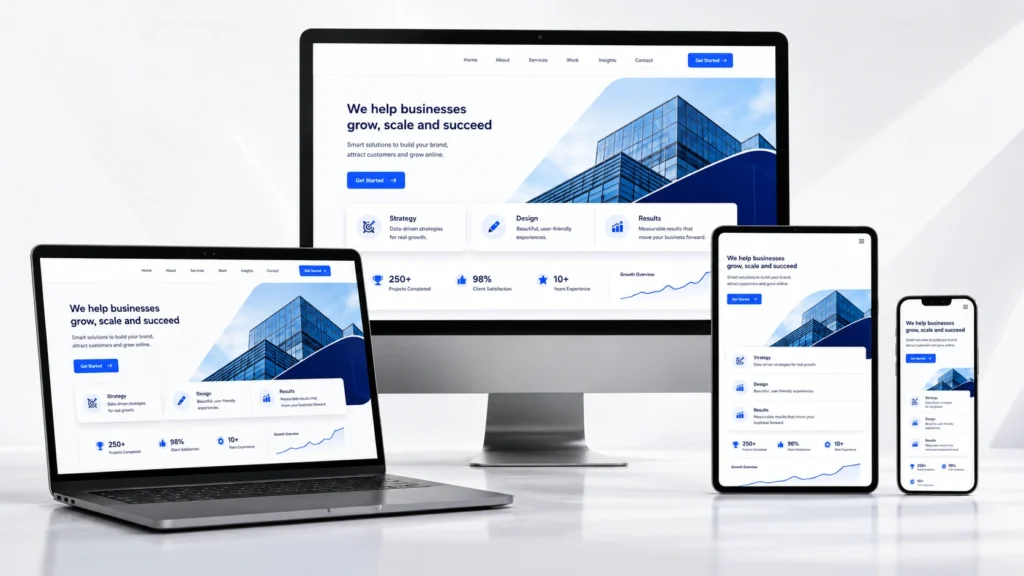
Simply having a website is not enough.
A business website should create a professional, secure, and easy experience for customers.
Responsive, Mobile-First Design
Your website needs to work across smartphones, tablets, laptops and desktop screens.
Buttons should be easy to use.
Text should be readable.
Forms should work correctly.
Navigation should remain simple.
Customers should never need to fight with your website to get information.
Fast Loading Performance
Visitors do not want to wait for unnecessarily heavy pages.
Images, scripts, fonts, hosting, caching, and database performance can all influence speed.
Performance optimization should therefore be part of development rather than something considered only after problems appear.
Clear Navigation
Users should quickly understand where to go.
A visitor should not need to search through complicated menus just to find your services or contact page.
Clarity usually converts better than unnecessary complexity.
Strong Calls to Action
Every important page should have a logical next action.
That may be:
Request a Quote
Book an Appointment
Shop Now
Call Us
Send a Message
Schedule a Consultation
Your CTA should match the visitor’s intent.
SEO-Friendly Structure
A professional website should have a logical hierarchy, crawlable pages, descriptive URLs, proper headings, optimized metadata, internal links, and other technical foundations.
SEO should not be treated as a plugin you install after the website has been completed.
It should influence the website architecture from the beginning.
SSL and Security
HTTPS is a basic expectation for modern websites.
Businesses should also think about secure logins, updates, backups, malware protection and access control.
This becomes especially important when processing customer information, bookings, accounts or payments.
Lead-Generation Forms
Contact forms should be simple enough to complete while collecting the information your business genuinely needs.
Too many unnecessary fields can create friction.
Too few fields may provide your sales team with insufficient context.
The right balance depends on the business.
Analytics and Conversion Tracking
If your website exists to produce business results, those results should be measured.
Tracking can help identify which marketing activities and pages are generating valuable actions.
Testimonials and Trust Signals
Potential customers want evidence.
Reviews, case studies, portfolio examples, genuine client results, business information and clear contact details can reduce uncertainty.
Accessibility
Websites should also be designed so that as many people as possible can use them.
Readable typography, keyboard-friendly interaction, sensible contrast, descriptive images and clean structure contribute to a better experience.
Booking or eCommerce Functionality
Businesses should add functionality based on actual customer needs.
A hotel may benefit from reservations.
A retailer may need WooCommerce.
A consultant may need appointment scheduling.
Functionality should solve problems rather than being added simply because it looks impressive.
CRM, Payment and API Integrations
As businesses grow, custom integrations can connect the website to existing systems and reduce repetitive manual work.
This is where a website can start becoming genuine digital infrastructure.
Website Speed and User Experience Matter More Than Simply Having a Website
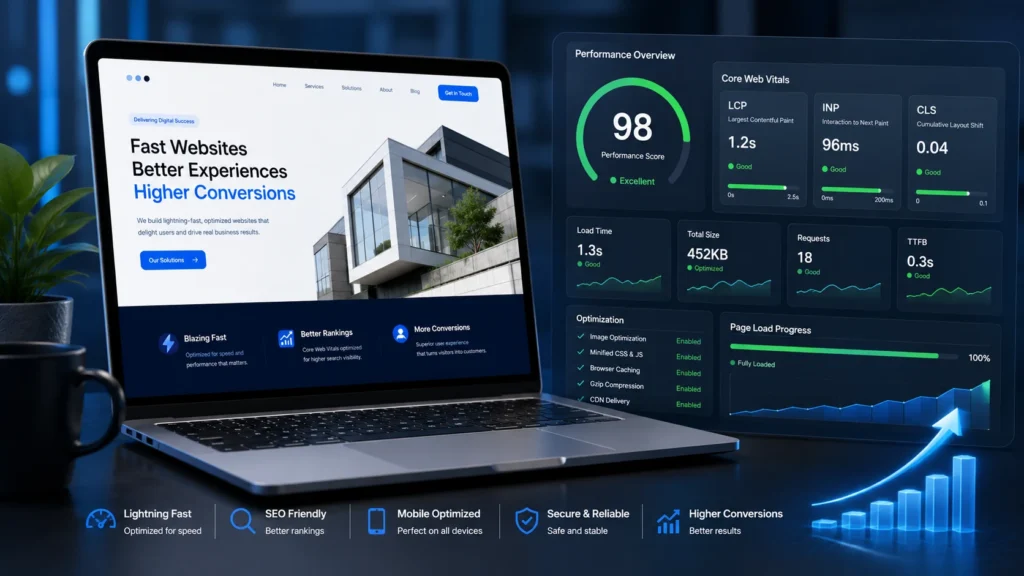
A business can technically have a website and still lose customers because of it.
Imagine clicking a result and waiting several seconds while a huge banner loads.
Then the page suddenly moves because another element appears.
You finally find the menu, but it is difficult to use on mobile.
You probably won’t stay long.
Your customers feel the same way.
Why Slow Websites Lose Opportunities
Every unnecessary delay creates friction between a visitor and the action you want them to take.
Speed is therefore not only an SEO issue.
It is a user-experience and conversion issue.
Good speed optimization may include image compression, caching, CDN configuration, efficient code, database optimization, and better hosting.
Core Web Vitals
Google’s Core Web Vitals measure important parts of real-world page experience.
The current metrics include Largest Contentful Paint (LCP) for loading performance, Interaction to Next Paint (INP) for responsiveness, and Cumulative Layout Shift (CLS) for visual stability.
Google recommends aiming for LCP within 2.5 seconds, INP below 200 milliseconds, and CLS below 0.1 at the 75th percentile of visits.
These metrics should not become the only thing you care about, but they provide useful indicators of technical user experience.
Mobile Usability
A mobile website should not feel like a compressed desktop website.
Buttons need adequate spacing.
Menus need to work naturally.
Forms need to be manageable on small screens.
Important information should appear without excessive scrolling or interaction.
Simple Conversion Journeys
The best-performing website journey is often the clearest one.
If somebody reaches a service page, they should quickly understand:
What do you offer?
Who is it for?
What problem does it solve?
Why should they trust you?
What should they do next?
Everything else should support those questions.
Which Type of Website Does Your Business Need?
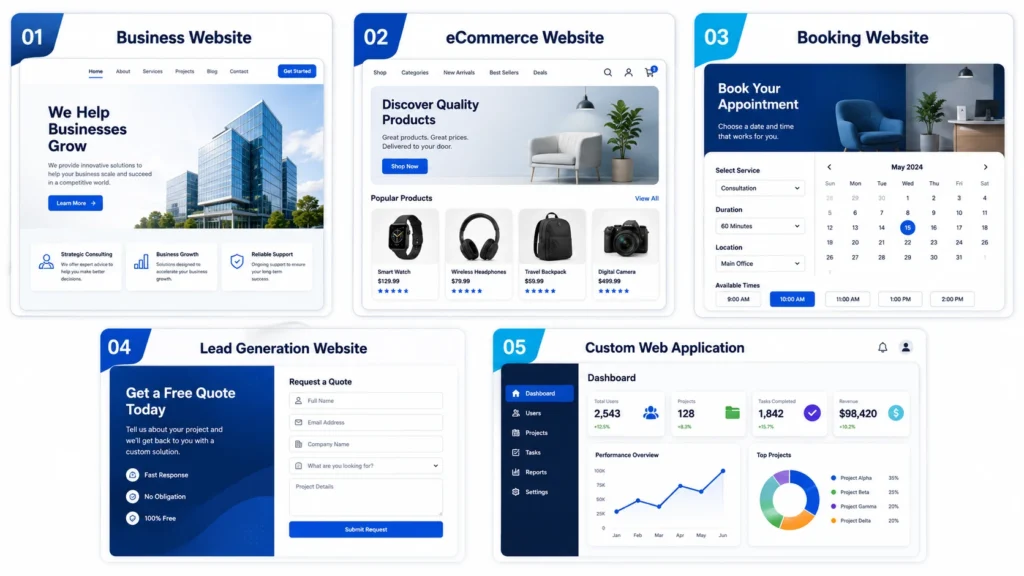
Different businesses require different digital solutions.
| Business Type | Recommended Website |
| Local service company | Lead-generation website |
| Consultant | Personal or business website |
| Retail store | eCommerce website |
| Hotel | Booking website |
| Clinic | Appointment website |
| Restaurant | Menu and reservation website |
| Startup | Scalable custom website |
| B2B company | Corporate website with CRM integration |
| Membership business | Membership or customer portal |
Professional Website for Small Businesses
This works well for companies that primarily need to communicate services, build credibility, and generate enquiries.
Lead-Generation Website for Service Businesses
A lead-generation website is intentionally structured around attracting qualified visitors and converting them into enquiries.
eCommerce Website for Online Sales
An eCommerce website is appropriate when customers need to browse and purchase products directly online.
Booking Website for Service-Based Businesses
Hotels, clinics, consultants, travel companies and similar businesses can use booking functionality to automate appointments or reservations.
Custom Website for Growing Companies
Businesses with workflows that cannot be handled by standard website functionality may require custom development, APIs, portals, dashboards or tailored WordPress solutions.
The right choice depends on your business model rather than what happens to be popular.
How to Build a Business Website That Actually Generates Growth
A successful website should begin with strategy rather than design.
Step 1 – Define Your Business Growth Goals
Decide what success means.
Do you want leads?
Sales?
Bookings?
Phone calls?
Store visits?
Brand awareness?
Without a clear goal, it becomes difficult to design the correct customer journey.
Step 2 – Understand Your Target Customers
Understand who will use the website.
What are they searching for?
What problems are they trying to solve?
What questions do they ask before buying?
What prevents them from choosing a provider?
Your website should answer those questions.
Step 3 – Choose Your Domain and Hosting
Choose a professional domain that represents your brand and reliable hosting appropriate for your expected traffic and functionality.
Poor hosting can undermine an otherwise well-developed website.
Step 4 – Plan the Website Architecture
Create the structure before development.
A basic structure may look like:
Home → Services → Individual Service Pages → About → Projects → Blog → Contact
Larger businesses may require product categories, location pages, resources, booking sections or account areas.
Step 5 – Design for Mobile Users
Plan important sections, forms, and interactions with mobile usability in mind.
Responsive design should be fundamental, not an afterthought.
Step 6 – Develop the Website Properly
The development stage transforms the strategy and design into a functional digital product.
Code quality, CMS configuration, plugins, integrations, security, and scalability all matter here.
Step 7 – Implement SEO and Digital Marketing
Set up the technical and structural foundations that help search engines discover and understand your pages.
SEO works best when incorporated throughout development.
Step 8 – Optimize Performance
Optimize images, caching, scripts, fonts, hosting, and other performance factors.
Test actual pages rather than assuming the website is fast.
Step 9 – Add Conversion Tracking
Define valuable actions and measure them.
This turns the website from something you simply own into something you can evaluate.
Step 10 – Maintain and Improve the Website
Launching is not the final step.
Businesses change.
Services change.
Technology changes.
Customer expectations change.
The website should evolve with them.
How Much Does a Business Website Cost in 2026?
There is no universal price for a professional business website.
A five-page informational website and a custom WooCommerce platform with payment gateways, booking functionality, and third-party integrations require completely different levels of work.
What Determines Website Development Cost?
Website pricing is usually influenced by the number of pages, custom design requirements, content requirements, eCommerce features, payment gateways, booking systems, custom functionality, API integrations, SEO requirements, hosting, and ongoing maintenance.
Two websites that look similar on the surface can have very different technical requirements behind them.
Cheap Website vs Professional Website Investment
Budget is naturally important.
However, selecting a website entirely on the lowest initial price can become expensive later.
Poor development can lead to slow performance, security problems, plugin conflicts, difficult maintenance, limited scalability, and eventual redevelopment.
A professional website should be considered in terms of long-term business value.
Think About ROI Instead of Development Cost Alone
Imagine one website costs less but generates almost no enquiries.
Another requires a larger initial investment but consistently attracts relevant traffic and generates qualified leads.
Which one is actually cheaper?
The more useful question is:
“What value can this website generate for my business?”
rather than:
“How cheaply can I get a website online?”
Common Website Mistakes That Stop Business Growth
Many websites fail because they were created without a clear strategy.
Building Without a Business Objective
A website designed without knowing its goal usually becomes a collection of pages rather than a conversion tool.
Ignoring Mobile Users
Poor mobile experiences can immediately push potential customers toward competitors.
Slow Page Speeds
Oversized images, unnecessary scripts, excessive plugins, and weak hosting can significantly damage performance.
Weak SEO Structure
If important pages cannot be discovered or properly understood by search engines, you may be limiting organic visibility from the beginning.
No Clear Call to Action
Visitors should never need to wonder what to do next.
Too Much Content Without Visual Hierarchy
More content does not automatically create a better website.
Users need headings, spacing, and structure so they can quickly understand information.
Using Low-Quality Hosting
Hosting affects reliability, security, and performance.
It should match the needs of the website.
Ignoring Security and Updates
WordPress core, themes, plugins, and server software need ongoing attention.
Neglect creates unnecessary risk.
Not Measuring Conversions
A thousand visitors mean very little if you don’t understand whether they produce valuable actions.
Creating One Generic Services Page
Individual service pages can provide significantly more detail for users while creating better opportunities to target specific search intent.
Depending Entirely on Plugins Without Maintenance
Plugins can be extremely useful, but adding too many poorly selected tools can introduce performance, compatibility, and security problems.
Use technology because it solves a requirement, not because it is available.
Business Website Best Practices for 2026
The strongest business websites are built around customers rather than search-engine tricks.
Google’s own guidance recommends creating helpful, reliable, people-first content that provides substantial value and demonstrates genuine experience or expertise.
Start with search intent. Understand what users expect when they reach each page and answer that need clearly.
Create dedicated service pages instead of hiding every offering inside one generic page.
Demonstrate real expertise through projects, case studies, screenshots, genuine reviews, and practical insights.
Keep important information accurate and update content when something has genuinely changed.
Optimize images and website performance so useful information is delivered quickly.
Create strong internal links so users and search engines can discover related pages.
Use appropriate structured data where it genuinely describes page content.
Create clear conversion paths.
Measure traffic and conversions rather than judging success by appearance alone.
Finally, maintain security, updates, backups, and performance after launch through ongoing hosting and website maintenance.
When Does Your Business Need Custom Website Functionality?
Standard website functionality works for many businesses.
Others eventually reach a point where existing tools cannot efficiently handle their processes.
That is where custom development can create significant value.
Custom Booking Workflows
A business may need more than a simple date picker.
Hotels may need room availability.
Clinics may need different specialists and appointment lengths.
Rental businesses may need inventory availability.
Custom booking functionality can adapt the system around the actual business workflow.
CRM Connections
Connecting enquiries with a CRM reduces repetitive manual work and helps sales teams manage leads more effectively.
Payment Gateway Integrations
Businesses may require specific payment providers, subscription systems, deposits, recurring payments or custom checkout logic.
Custom Functionality
Sometimes existing plugins provide 70% of what a business needs but make the remaining 30% unnecessarily complicated.
A custom plugin can provide functionality designed specifically around the requirement instead of forcing the business to adapt to a generic solution.
Inventory and Business Automation
Websites can also exchange information with inventory platforms, external APIs, email systems, and other business tools.
The goal is simple:
Use technology to remove unnecessary work and create a smoother experience for both your team and your customers.
Is It Better to Build Your Own Website or Hire a Web Developer?
Both approaches can make sense depending on your situation.
When DIY May Be Enough
A DIY website may be appropriate when you are testing a new idea, working with a very limited budget, creating a temporary landing page or building something where advanced SEO, performance, and custom functionality are not important.
It can help you validate an idea before making a larger investment.
When Professional Development Makes Sense
Professional website development becomes more valuable when the website is expected to generate leads, rank competitively in search engines, process eCommerce transactions, manage bookings, integrate with external systems or represent an established brand.
Professional development also matters when scalability, speed, security, and maintainability are important.
The question is not simply whether you can build a website yourself.
The question is whether the website is important enough to your business that it should be built strategically.
Questions to Ask a Web Developer
Before hiring someone, ask whether the website will be responsive, how SEO will be considered during development, who owns the finished website, how updates will be managed, what security practices will be implemented, and whether the architecture can support future expansion.
A good developer should be interested in your business objectives rather than only asking what colors you want.
How a Professional Website Becomes a Business Growth System
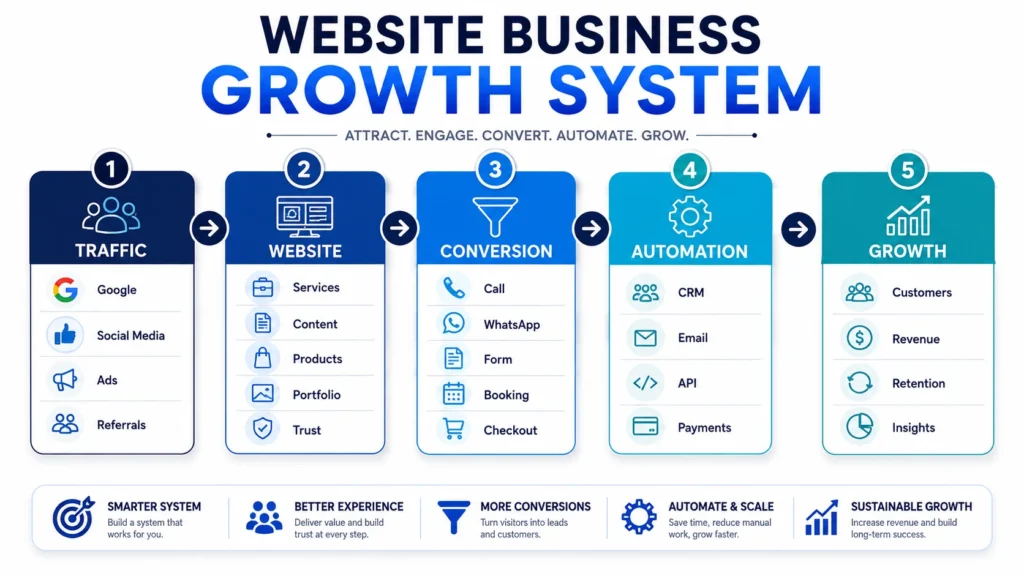
This is the most important idea to understand.
A website should not exist in isolation.
Imagine the complete system.
Traffic arrives from Google, social media, advertising, referrals, and direct visitors.
Those visitors reach your website, where they discover your services, content, products, portfolio and proof of expertise.
The website creates a conversion through a phone call, WhatsApp message, enquiry form, booking or checkout.
The information can then connect with automation such as CRM software, email systems, APIs and payment platforms.
Those processes create growth through more customers, revenue, retention and business insights.
In simple terms:
Traffic → Website → Conversion → Automation → Growth
That is what a modern business website can become.
Not simply something customers look at.
Something that actively supports how the business operates and grows.
Ready to Build a Website That Helps Your Business Grow?
A professional website in 2026 requires more than attractive design.
It needs the right combination of:
Design + Development + SEO + Speed + Conversion + Maintenance
I’m Deyan Kavindu, a Web Developer and SEO Specialist based in Sri Lanka, with more than four years of hands-on experience creating digital solutions for businesses. My work includes professional WordPress websites, WooCommerce stores, booking platforms, technical SEO, Core Web Vitals optimization, API integrations, and custom WordPress functionality.
My approach is simple: understand the business goal first, then build the technology around it.
Whether you need a professional business website, an eCommerce store, an online booking system, technical SEO improvements, custom functionality, or a faster existing website, the objective should always be the same:
Build a website that supports real business growth.
Ready to improve your online presence? Discuss your website project or request a website consultation today.
Frequently Asked Questions
Does Every Business Need a Website in 2026?
Most businesses can benefit significantly from having a professional website in 2026. A website builds credibility, gives customers reliable information, creates opportunities for Google visibility, supports lead generation and provides a digital platform that the business controls. The exact type of website required will depend on the company’s goals and customers.
Why Is a Website Important for Business Growth?
A website can support business growth by increasing online visibility, building customer trust, generating enquiries, enabling online sales and connecting marketing channels with measurable conversions. When combined with SEO, useful content and effective calls to action, a website can become a long-term customer acquisition platform.
Do I Need a Website If My Business Already Has Facebook or Instagram?
Yes, in most cases. Facebook and Instagram are excellent for discovery and engagement, but your business does not control those platforms. A website gives you greater control over your brand, content, SEO, customer journey, analytics, and conversions. The strongest strategy is usually to use social media to support your website rather than replace it.
Can a Small Business Succeed Without a Website?
Some small businesses can operate without a website, particularly when they depend heavily on referrals or marketplace platforms. However, not having a website can limit credibility, Google visibility and opportunities to attract new customers. Even a relatively simple professional website can provide a strong foundation for future digital growth.
How Does a Website Help Attract New Customers?
A website can attract customers through search engines, social media, advertising, referrals and direct visits. SEO can help relevant pages appear when potential customers search for your products or services. The website then converts those visitors through calls, forms, bookings, purchases or other actions.
Does Having a Website Help My Business Rank on Google?
Simply having a website does not guarantee Google rankings. Search visibility depends on many factors, including content quality, relevance, technical SEO, crawlability, website structure, page experience, and competition. A professionally built website provides the foundation required for an effective SEO strategy.
What Should a Business Website Include in 2026?
A strong business website should include mobile-responsive design, clear service or product information, easy navigation, contact details, effective calls to action, security, SEO-friendly architecture, fast performance, analytics, and genuine trust signals such as testimonials or case studies. Additional functionality should be based on the needs of the business.
How Much Does a Business Website Cost in 2026?
Website development costs vary depending on project complexity. The number of pages, custom design, eCommerce functionality, booking systems, payment gateways, API integrations, SEO requirements, custom development, and ongoing maintenance can all influence the final cost. A professional quotation should therefore be based on the actual project requirements.
How Long Does It Take to Build a Business Website?
The timeline depends on the website’s scope, content, design complexity, and functionality. A straightforward business website can generally be completed faster than an eCommerce platform or custom website requiring advanced integrations. Proper planning, prepared content, and timely feedback can also significantly influence the project schedule.
Should I Build My Business Website Myself or Hire a Professional Developer?
A DIY website may be suitable for testing a simple idea or working with a very limited budget. Hiring a professional developer makes more sense when your website is expected to generate leads, rank on Google, process transactions, manage bookings, integrate with other systems, or become an important long-term business asset.
Your Website Should Work for Your Business
The question in 2026 is no longer simply:
“Does my business need a website?”
A better question is:
“What should my website be doing for my business?”
It should build credibility.
It should help potential customers discover you.
It should explain why your solution matters.
It should make contacting, booking, or buying from you easier.
It should provide measurable information about your marketing.
And where appropriate, it should automate processes that would otherwise require manual work.
Your website can become the connection between your marketing, customers, and business operations.
That is why every business needs a website in 2026 for growth, not simply to exist online, but to create a digital platform that can attract customers, build trust, generate opportunities and grow alongside the business.